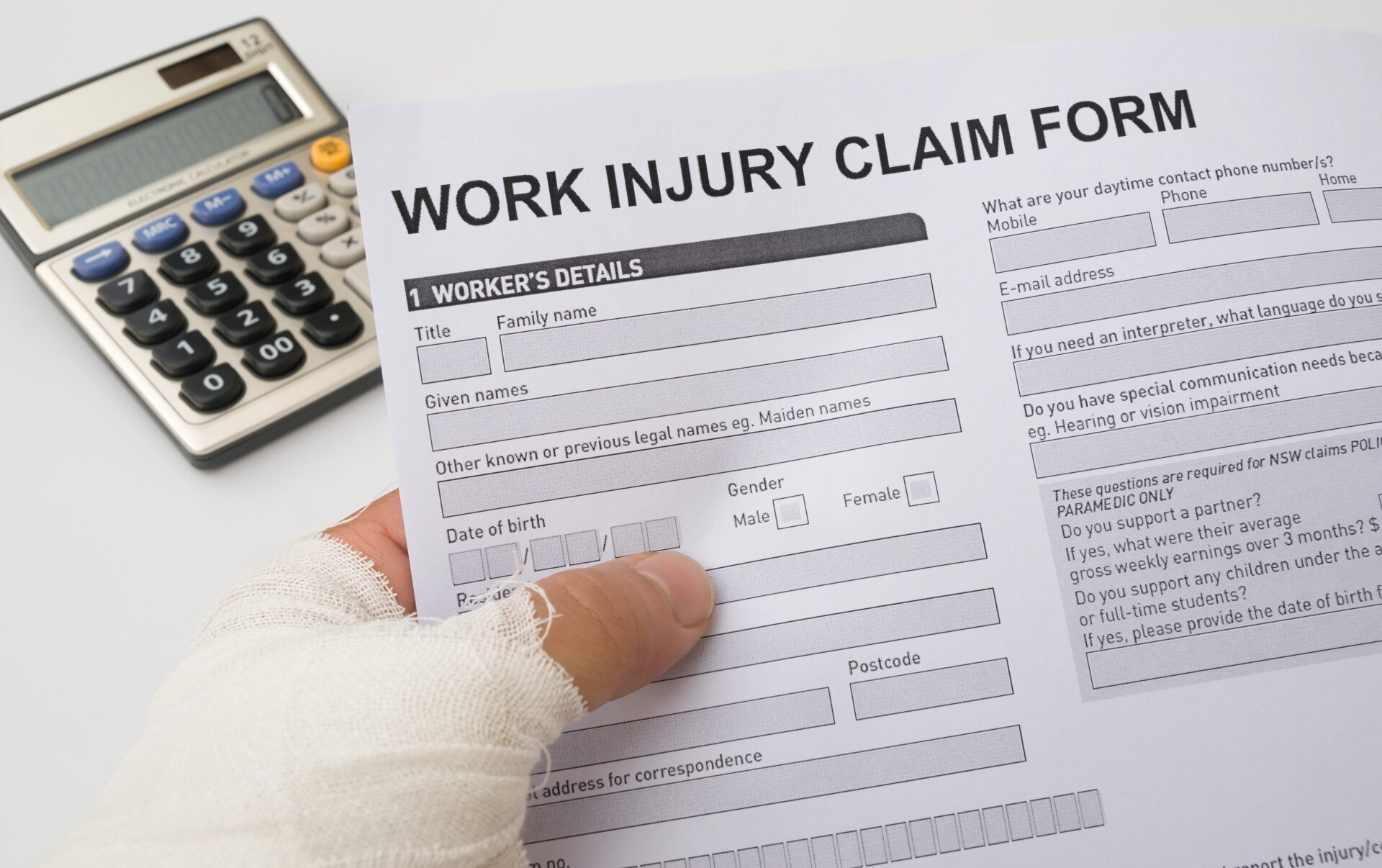
Making a claim for compensation
In this edition, we revisit the basics of making workers compensation claims and remind claimants and employers about their respective obligations under the Act.
Making a claim for compensation
Worker’s obligations – Notice of injury
A worker who suffers an injury while working or because of work, must tell their employer as soon as practicable after suffering that injury. In this context, as soon as practicable would probably be at the first available opportunity.
Injured workers must tell their employer about a work-caused injury before voluntarily leaving the employment that the injury occurred in.
Notice of an injury can be given verbally or in writing.
Employer’s obligations – The right to make a claim
Within 14 days of receiving this notification, the employer must inform the worker of their right to make a claim for compensation by giving them a notice in a prescribed form.
Employers who do not know how to access the prescribed form, should contact their workers compensation insurer.
If a worker wishes to make a workers compensation claim and asks for a worker’s claim for compensation form, an employer must supply it and must not obstruct the worker.
Managing injuries and claims in-house
It is not uncommon for employers to have internal processes for supporting injured workers, managing recovery processes, and accessing treatment. Whilst having robust injury management processes and well-defined policies is encouraged, employers are reminded that those processes and policies cannot be seen to be, inadvertently, breaching the requirements under the Act.
Time limits for making a claim
In most cases, the injured worker must make their claim within six months of the date of their injury.
Failing to make a claim within these timeframes will not make a worker’s claim invalid if the failure was due to mistake, the worker’s absence from Tasmania, or other reasonable cause.
A reasonable cause could include:
- the employer making a payment to the worker that they believe is a payment of compensation.
- the employer failing to provide the Notice of Right to Make a Workers Compensation Claim.
- the employer telling the worker that compensation will (or will not) be payable.
As such, while WHS obligations and a caring workplace would make most employers readily support the worker and embark on internal injury-management and wellness-related processes, should there be a delay in the making of the claim and that delay is because of the worker’s belief that falls within one of the reasonable causes, then employers would not be able to rely on the delay of the making of the claim to dispute liability for the worker’s claim.
Other key considerations
Workers are expected to promptly notify their employer about a work-caused injury so that employers can fulfil their obligations in a timely manner and so that employers can promptly lodge the claim with their workers compensation insurer. The insurer can then step into the shoes of the employer, and manage the claim including supporting the worker to access treatment promptly.
At times, some claims require investigation (both medical as well as factual). Some investigations are also necessary and need to be done shortly after the alleged injury so that liability can be properly assessed. As such, if notice of an injury is not given promptly, an employer can be prejudiced in its ability to defend the claim.
As for workers, ignorance of the law is not a valid excuse for workers to not give notice of an injury promptly.
Further, the prejudice consideration only applies to the timeframes for giving notice of an injury. Employers need not show they are prejudiced if the claim is not made within six months.
Status updates in 28 days
Employers and insurers are also reminded of a key provision in the Act. Section 39 of the Act requires employers or their insurers to give workers/claimants a notice of the status of the claim within 28 days.
Either the employer can give this status update or their insurer – it is not necessary for both parties to do this.
Employers and their insurers should keep in mind that this is a penalty provision i.e., failure to comply with this section could result in a fine of not more than 10 penalty units.
Insurers who would like a refresher / case management training on the preliminary requirements for the making of claims and the immediate steps required following receipt of a workers compensation claim, can reach out to us.