

Beat the bargaining clock: Preparing for your next Enterprise Agreement
If your business negotiated an enterprise agreement during the post-pandemic bargaining wave of 2022 or 2023, its nominal expiry date may be fast approaching.
While an enterprise agreement continues to operate until it is replaced or terminated, allowing it to expire can affect your bargaining position. Protected industrial action may disrupt operations and affect your organisation’s ability to attract and retain employees. To ensure your organisation is in the best position to bargain, we recommend a proactive approach. Start preparing for bargaining at least six months before the agreement’s nominal expiry date.
What are the first steps ?
Step 1: Know the workforce and what is important to them
Before bargaining begins, understand who makes up your workforce and what matters to them. This will help you identify the combination of pay and conditions employees are most likely to support when the agreement is put to a vote. Because an employer’s resources are finite, this groundwork is critical to developing the best overall value proposition. It also helps distinguish broader workforce priorities from claims advanced by individual bargaining representatives, which may be costly but have limited support across the workforce. Employee surveys are a useful starting point, as is discussions with managers about what their teams value.
Step 2: Set the budget
Before bargaining begins, employers should confirm the budget available for the proposed term of the new enterprise agreement. This provides a clear basis for determining the maximum spend across the life of the agreement and helps frame starting offers and negotiation points. Failing to set a budget at the outset can cause delay and unexpected budget spend.
Tip: Ask your CFO for the current budget and three-year projections for employees covered by the enterprise agreement.
Step 3: Prepare the log of claims
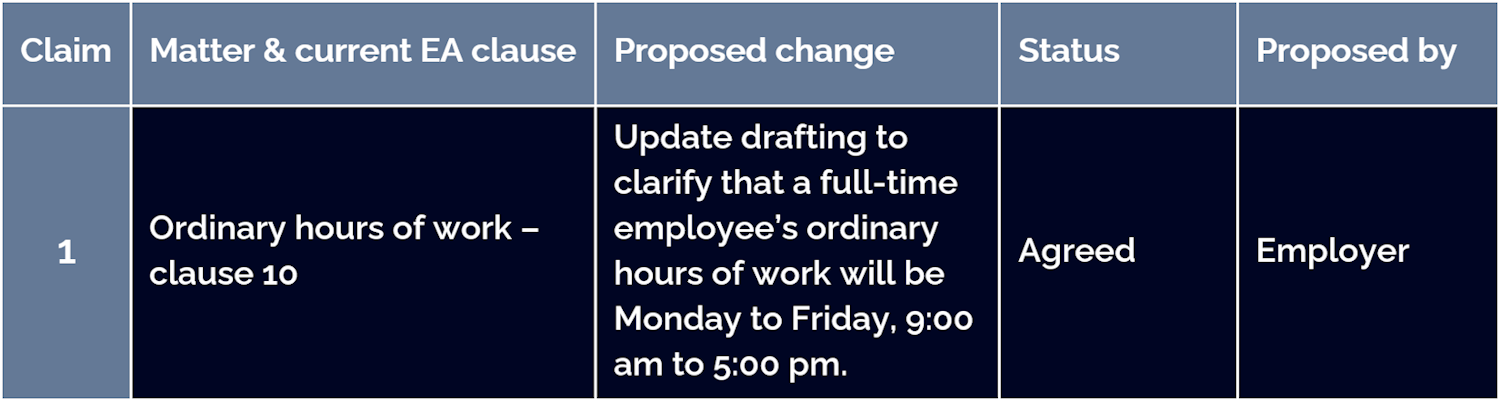
A log of claims is a living record of proposed changes to the current enterprise agreement and the outcomes of negotiations.
Employer representatives should put themselves in the shoes of their employees and consider what they are likely to say in respect of the matters likely to be negotiated. From there, it can be helpful to include the employer’s first position in the log of claims, with fall-back positions to be reserved for later negotiations.
Tip: When preparing the log of claims, review the current agreement and identify any terms or conditions that have been unclear or the subject of dispute. Speak to your payroll team about the issues that they have found. Often, the payroll team has the greatest insight into EBA inconsistencies and pain points. Your log of claims table might look something like the below:
Step 4: Initiate bargaining for a new enterprise agreement
Getting on the front foot and initiating bargaining for a new enterprise agreement prior to the expiry date, although not essential, avoids employers feeling under pressure to negotiate a new agreement after it has expired and limits the likelihood of employees taking protected industrial action. Some enterprise agreements will have a date range for bargaining to commence. The employer can issue the Notice of Employee Representational Rights (NERR) as soon as it is ready; it does not need the agreement of the union or employees to commence bargaining.
Tip: Before formally commencing bargaining, check whether your current enterprise agreement or organisational procedures require any additional steps.
Step 5: Issue the NERR
Once the employer has agreed to bargain, it needs to issue the prescribed NERR to employees. The NERR is the formal commencement of bargaining, and it contains information about bargaining for a new agreement, the rights of employees to appoint a representative and the rights of the union. The NERR must be in the form prescribed on the Fair Work Commission’s (FWC’s) website and the text cannot be changed, save for inserting the relevant details of the employer.
Tip: Ensure the NERR matches the FWC template exactly and is readily accessible to all employees. For example, outdoor workers may require printed copies in lunchrooms, whereas administrative staff may only need electronic copies.
What matters should we be prepared to negotiate about?
The types of matters usually negotiated include:
- rates of pay;
- ordinary hours;
- penalty rates, overtime rates and allowances;
- payment for end-of-year shutdown periods;
- leave entitlements (such as annual leave, personal leave and parental leave); and
- performance and promotion review mechanisms.
It is important to note that the workplace relations landscape may have shifted considerably since your agreement was made. Recent changes to the Fair Work Act 2009 (Cth) include the right to disconnect, ‘same job, same pay’ reforms and, in some circumstances, requirements for employers to bargain alongside other employers through the FWC’s supported bargaining process.
These amendments are important to keep in mind when preparing for negotiations, as employee representatives or union members may be keen to see those rights reflected in your agreement.
When to seek advice
If your agreement has already expired, don’t panic. We recommend taking the steps outlined above as soon as possible with a view to prioritising bargaining for this financial year.
If your agreement is near its expiry (i.e. it has less than one year remaining), stay ahead of the bargaining clock and seek advice now, particularly if you are bargaining for the first time or expect the agreement to be complex or require significant redrafting.
Starting preparations well before the nominal expiry date allows time to resolve issues, confirm your bargaining position and take any necessary action before employees are formally notified of your intention to bargain.

